

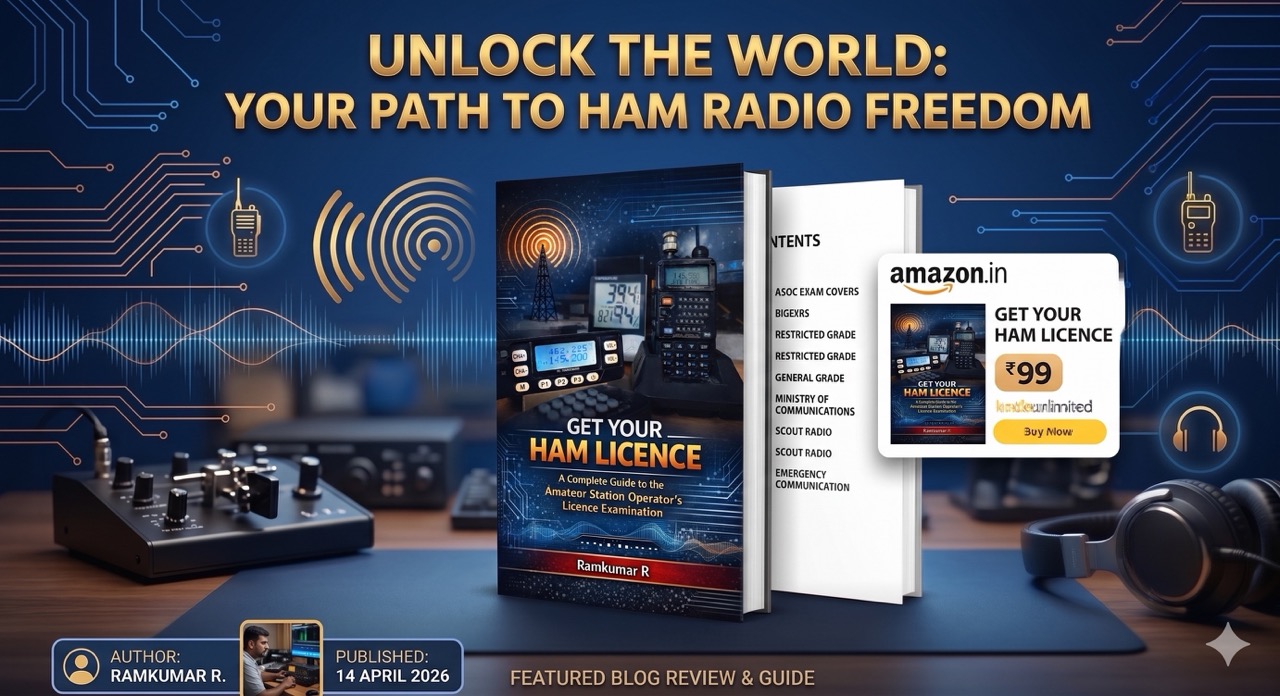
Demystifying Amateur Radio: Your Ultimate Guide to Getting Licensed in India
Have you ever wondered what it would be like to talk to someone on the other side of the planet using nothing but a radio transceiver and a wire antenna slung over a tree? Or how disaster relief volunteers manage to coordinate rescues when cyclones or earthquakes completely wipe out cell towers and the internet?
Welcome to the incredible, global community of Amateur Radio—more affectionately known as HAM Radio.
For decades, this hobby has brought together tech enthusiasts, engineers, tinkers, and community servants. Yet, for beginners in India, breaking into the hobby has historically felt like staring at a brick wall. The exam syllabus seemed incredibly technical, and the right study materials were scattered across archaic PDFs, deep web forums, or geared entirely toward the American FCC exams.
That is exactly why Ramkumar R (VU3WMV), a passionate licensed radio amateur and scout leader, wrote Get Your HAM Licence (published by Scout Library). It is the missing manual the Indian HAM community has desperately needed—a single, beginner-friendly roadmap designed from the ground up to help you pass the Indian ASOC (Amateur Station Operator’s Certificate) exam.
What Makes This Guide a Game-Changer?
If you’ve ever tried picking up an electronics textbook only to get immediately bogged down by complex calculus and dry formatting, you’ll find this book a breath of fresh air.
- Tailored for the Indian Syllabus: Unlike 90% of the material online, this guide directly follows the guidelines set by the Wireless Planning & Coordination (WPC) Wing of the Ministry of Communications, India. It explicitly covers the Indian Wireless Telegraphs Rules and local callsign allocations.
- From Zero to Hero: The book assumes you know absolutely nothing about electronics. It doesn’t start with complex circuitry; it starts with an atom.
- Intuitive Analogies: Instead of forcing you to memorize formulas, complex concepts are taught using everyday examples. For instance, electrical resistance is explained through a water-pipe analogy, and capacitors are introduced conceptually as two basic metal plates long before any math is thrown at you.
- Two Grades, One Book: Whether you are aiming for the entry-level Restricted Grade or want to go all out for the General Grade (which includes Morse Code), this book covers both.
A Sneak Peek Inside the 22 Chapters
The book is structured into four highly logical parts that gently ramp up the difficulty:
| Book Section | Topics Covered | Best For |
| Part I: Radio Theory & Practice (Ch 1–13) | Electricity fundamentals, Ohm’s law, magnetism, transmitters, receivers, and antennas. | Restricted & General Grades (The core foundation of radio electronics). |
| Part II: General Grade Topics (Ch 14–18) | Advanced modulation (AM, FM, SSB), power supplies, advanced propagation, and space communication. | General Grade (For those wanting higher power limits and HF bands). |
| Part III: Radio Regulations (Ch 19–21) | Indian Wireless Telegraphs Rules, ITU regulations, the phonetic alphabet, and Q-codes. | Both Grades (Crucial for passing the legal/regulatory section of the exam). |
| Part IV: Morse Code (Ch 22 + Appendices) | Morse alphabet, timing, exam prep, band charts, and sample question papers. | General Grade Applicants (Mastering the art of CW/Morse communication). |
Who is this book for?
HAM radio isn’t just for engineering students. It’s an expansive, multi-faceted hobby that appeals to a diverse range of people:
- Students & Tech Hobbyists: If you love DIY projects, programming, or physics, building your own antenna and making a contact is the ultimate reward.
- Scouts & Guides: Amateur radio has a deep, historic connection with scouting (think JOTA-JOTI). It teaches self-reliance, communication skills, and community safety.
- Emergency & Disaster Volunteers: When a massive storm hits, internet routing breaks and cellular networks congest. HAM radio operators are often the only civilian link left to call for medical help or coordinate relief supplies.
Ready to claim your own Callsign?
Your journey from a curious bystander to a licensed operator broadcasting under your own callsign (like VU3…) starts with proper preparation. Ramkumar R’s book bridges the gap between intimidating radio science and practical, everyday knowledge.
Every single chapter wraps up with 8 to 10 practice questions alongside fully worked-out, step-by-step numerical answers. By the time you reach the mock multiple-choice exams in the appendix, you’ll feel entirely confident walking into the examination hall.
The book is officially available on Amazon India in both convenient Kindle digital formats and physical Paperback editions.
Stop wondering how the airwaves work. Grab your copy of Get Your HAM Licence, master the fundamentals, pass your ASOC exam, and we’ll see you on the air!
73 (Best regards in amateur radio lingo) de Scout Library!